Vielen Dank für Ihr Interesse am unserem Newsletter!
Schauen Sie in Ihre Mailbox. Um die Anmeldung abzuschließen, müssen Sie die Bestätigungsmail beantworten oder dem darin enthaltenen Weblink folgen.
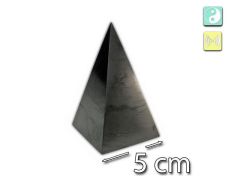
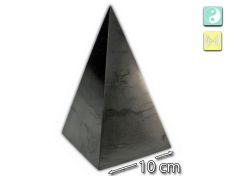
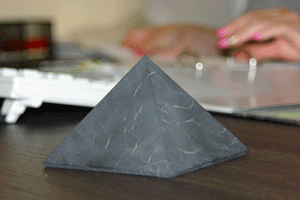
If you want to buy a large Shungite pyramid, you are choosing an exceptional object that combines natural stability, precise craftsmanship and harmonious geometry. The tall pyramid shape follows the principle of the Golden Ratio, a classical principle of proportion associated with balanced proportions, aesthetic harmony and a subtle visual effect. Each pyramid is therefore not only a decorative element, but also a clearly structured focal point that subtly enhances any room.
Our large Shungite pyramids are based on the so-called “Golod” shape, named after the Russian engineer Alexander Golod, who researched the effects of geometric forms on surrounding systems. Unlike classical pyramids, the height of the Golod pyramid is determined by the precise ratio of the radii of three interlocking circles. The result is a height-to-base ratio of approximately 2.058 and an angle of around 27.3° between the faces.
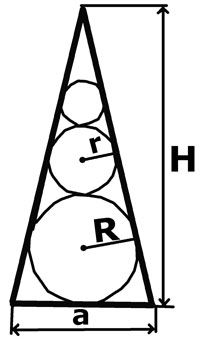
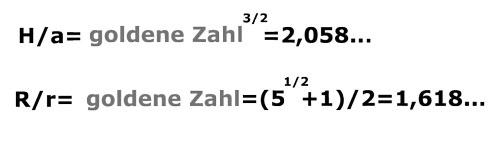
This special shape is traditionally regarded as harmonious and balanced. It creates not only an aesthetic presence in a room, but is also traditionally associated with subtle spatial balance and clarity. The pyramid can serve as a visual focal point that conveys a sense of calm, order and orientation – in neutral living areas, workspaces or meditation corners.
Shungite from the Zazhoginsky Mine in Karelia brings its unique northern character. According to traditional beliefs, this quality can contribute to an atmosphere of calm, stability and clarity in a room. Combined with the tall, distinctive shape of the Golod pyramid, it creates a harmonious focal point that can be perceived both visually and symbolically.
Grinding a large Shungite pyramid is a demanding form of craftsmanship. Only experienced stoneworkers can guide the long, straight lines precisely to the apex. Not every raw stone is suitable: only particularly stable pieces of high-quality classic Shungite (Category 2) are used. The stone must be robust enough to withstand processing without cracking or splitting.
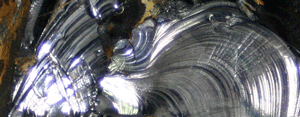
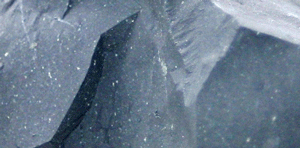
Large Shungite pyramids are available in both polished and unpolished versions. The polished variant features an elegant shine and is easy to clean. The unpolished pyramid displays the natural, matte structure of Shungite, which many people perceive as particularly authentic. The distinctive shape remains unchanged in both versions and retains its harmonious visual presence in the room.
For neutral areas, the following values can serve as general guidelines:
The tall, slender shape creates a clear focal point in the room. According to traditional interpretations, it can help subtly structure the atmosphere and convey a sense of calm and order.
If you want to buy a large Shungite pyramid, you are choosing an object that combines a distinctive shape, precise craftsmanship and the natural character of Shungite from northern Karelia. Whether as a decorative centrepiece, a harmonious element in living or working spaces, or as a special gift, Golod pyramids uniquely combine tradition, precision craftsmanship and aesthetic appeal.
Large Shungite pyramids are decorative and symbolic objects. No medical, therapeutic or health-related effects are claimed or guaranteed. Statements concerning “harmonisation” or “energetic effects” are based on traditional beliefs and personal experiences and are not scientifically proven properties.