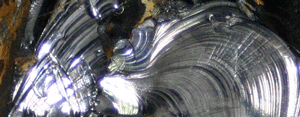
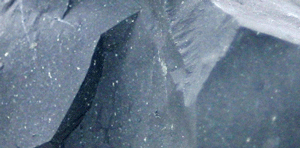
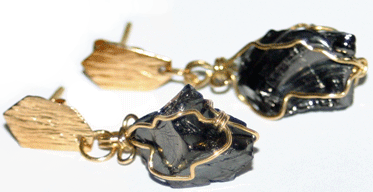
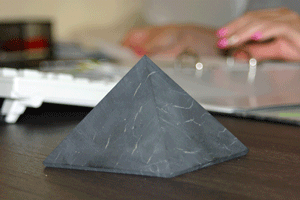
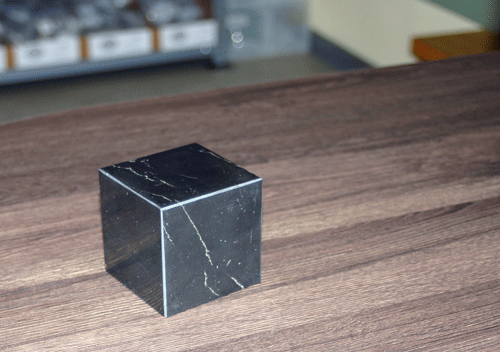
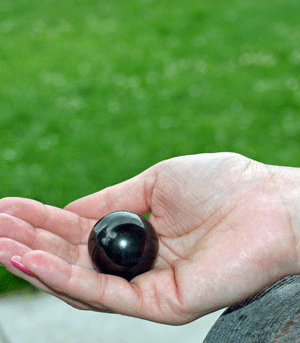
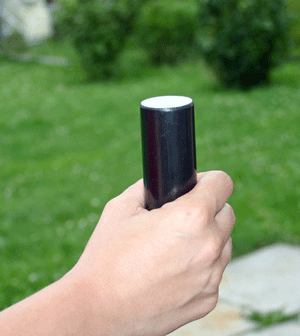
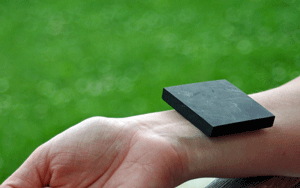
Around 2 billion years ago, nature created an extraordinary mineral that is still valued today for its protection against negative influences and its versatile benefits. The unique composition and special physical properties make Shungite and Elite Shungite truly exceptional.
However, there are some minerals that closely resemble Shungite and Elite Shungite in appearance and certain physical properties.
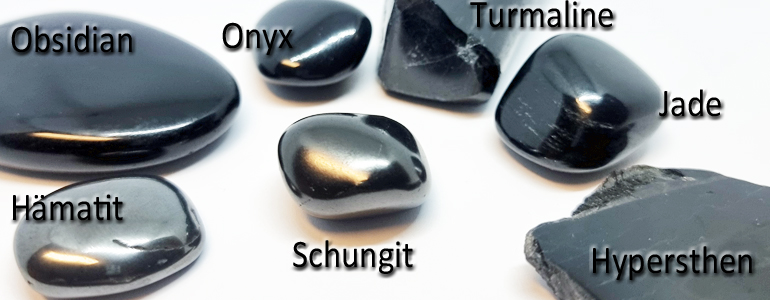
We have selected the six most common minerals that most closely resemble Shungite and Elite Shungite and are frequently found at mineral fairs. Although there are other similar minerals, our focus is on these widely known examples.
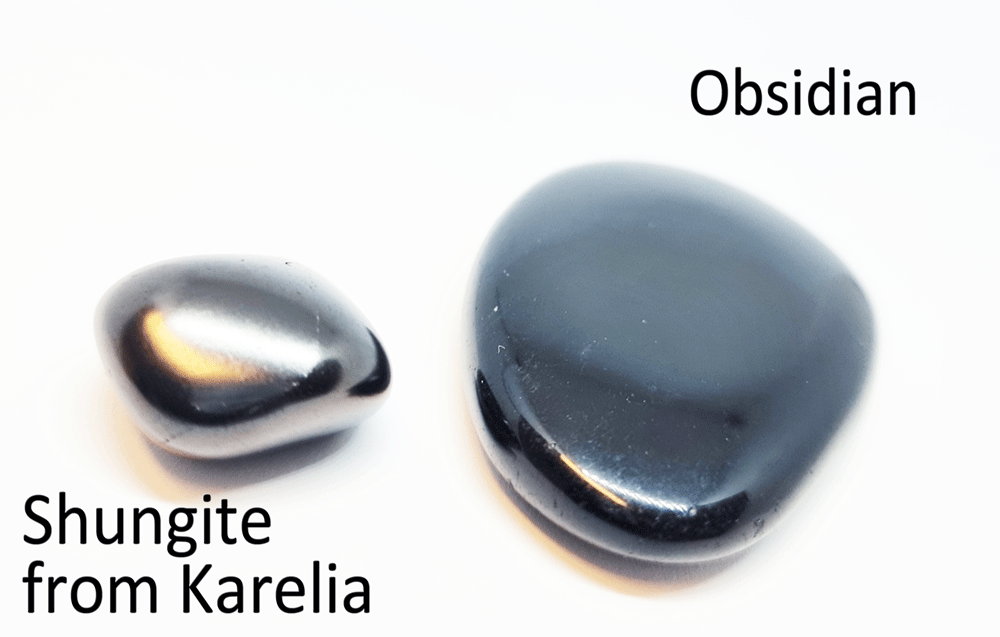
1. Obsidian
Formation: Obsidian is a volcanic glass rock that forms through the rapid cooling of lava. It is characterized by a deep black or dark brown color and a glassy sheen.
Physical Characteristics:
Conductivity: Unlike Shungite, which is electrically conductive, Obsidian does not conduct electricity.
Hardness: Obsidian has a Mohs hardness of 5 to 5.5, making it harder than Shungite, which has a hardness of 3.5 to 4.0.
Density: Obsidian has a density of 2.35 to 2.60 g/cm³, whereas Shungite’s density is 1.8 to 2.0 g/cm³. This makes Obsidian slightly heavier than Shungite.
Summary: Obsidian and Shungite differ significantly in origin and physical properties. In its raw state, Obsidian visually resembles Elite Shungite, while in polished form, it can look very similar to polished Shungite or Elite Shungite. However, a simple conductivity test can immediately clarify the difference, as Shungite is conductive, while Obsidian is not.
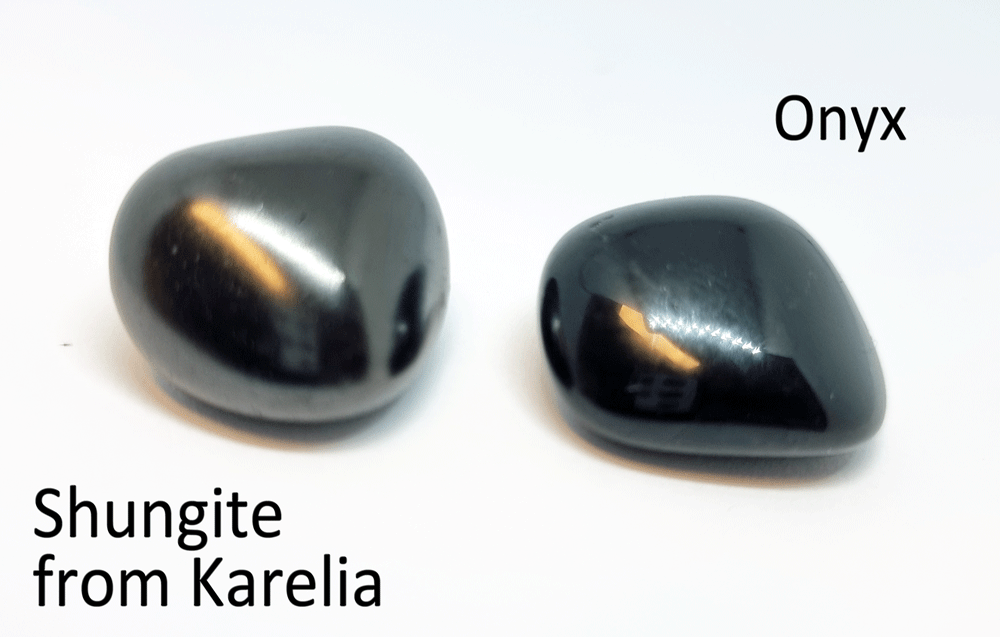
2. Onyx
Formation Onyx belongs to the chalcedony quartz family and primarily forms from hydrothermal silica solutions rich in manganese and iron compounds. It often exhibits characteristic black-and-white layering or a solid black appearance, which visually resembles Shungite.
Physical Characteristics:
Conductivity: Onyx does not conduct electricity, unlike Shungite.
Hardness: Onyx has a Mohs hardness of 6.5 to 7, making it significantly harder than Shungite, which has a hardness of 3.5 to 4.0.
Density: With a density of approximately 2.6 g/cm³, Onyx is heavier than Shungite, which has a density of 1.8 to 2.0 g/cm³.
Summary: Onyx and Shungite differ significantly in structure and chemical composition. While Onyx contains quartz (silicon dioxide), Shungite consists of carbon. However, polished Onyx closely resembles polished Shungite and can easily be mistaken for it. Upon closer inspection, Onyx’s surface typically displays a uniform, deep black color. Additionally, Onyx is heavier, and a simple test using a smartphone screen can confirm the difference, as Shungite is conductive while Onyx is not.
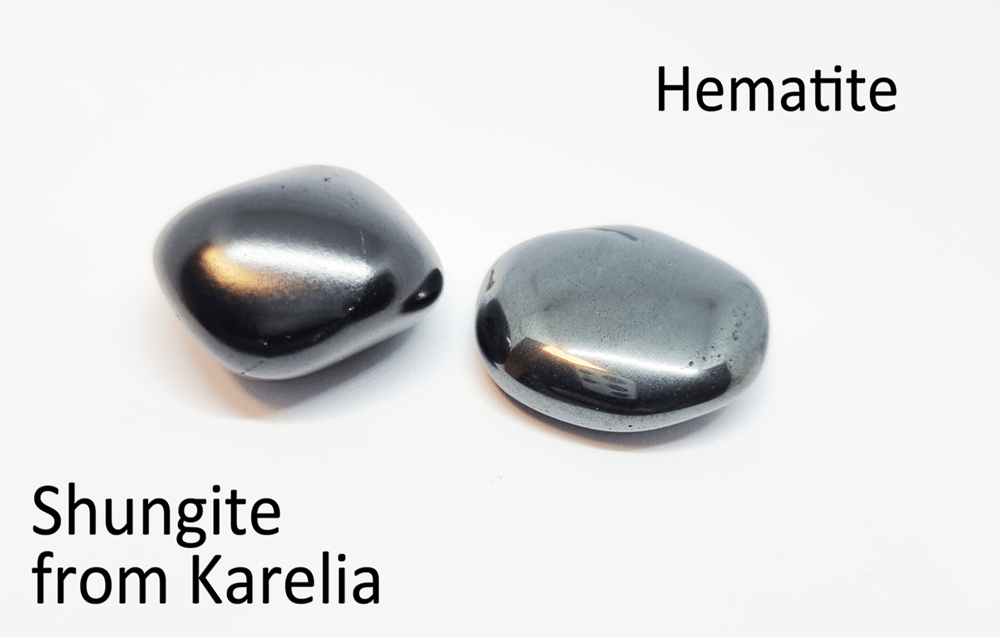
3. Hematite
Formation Hematite is an iron oxide mineral that forms through geological oxidation processes. It is often found in iron-rich deposits.
Physical Characteristics:
Conductivity: Hematite does not conduct electricity.
Hardness: With a hardness of 5.5 to 6.5, Hematite is harder than Shungite.
Density: Hematite has a density of 4.9 to 5.3 g/cm³, making it significantly denser than Shungite.
Summary:
Hematite is magnetic, which clearly distinguishes it from Shungite. Additionally, Hematite has a metallic luster and appears red in its powdered form. Another key difference is that Hematite conducts very little electricity, which can be confirmed using a multimeter.
Important:
A test using a smartphone screen does not provide conclusive results for Hematite. Many Hematite stones trigger a response on a smartphone screen, similar to Shungite. This characteristic is due to Hematite’s unique composition as an iron oxide mineral.
4. Jade
Formation Jade is a family of minerals consisting of two minerals: jadeite and nephrite. These minerals form under very high pressure and relatively low temperatures in metamorphic rocks.
Physical Characteristics:
Conductivity: Jade does not conduct electricity.
Hardness: The hardness is 6 to 7 on the Mohs scale, significantly higher than Shungite.
Density: Jadeite and nephrite have a density of 3.0 to 3.4 g/cm³, making them denser than Shungite.
Summary:
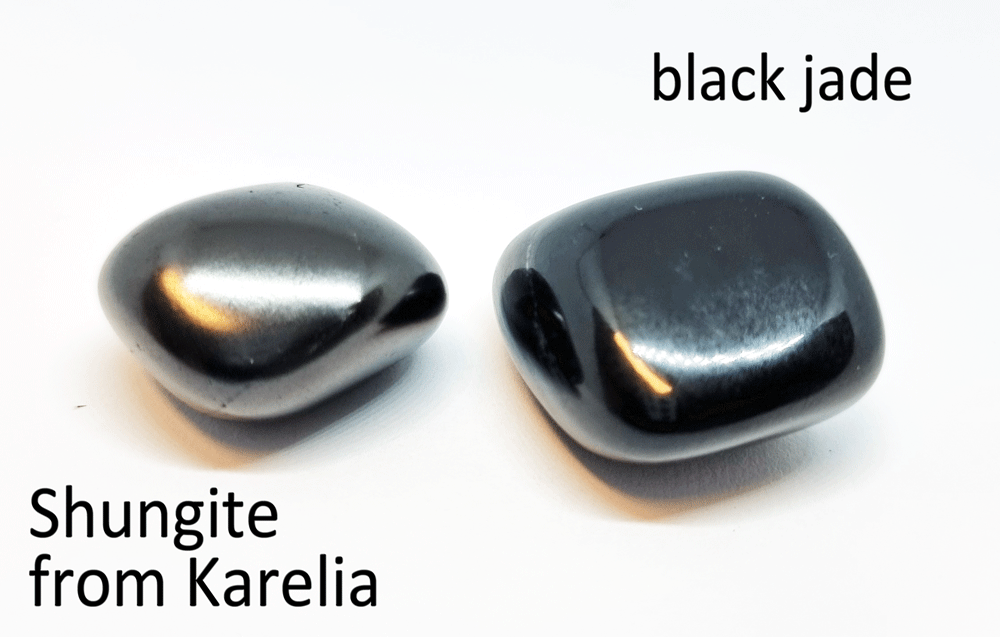
Jade naturally occurs in many different colors, including green, cream-white, pink, and black. In particular, the black variety of jade can be easily confused with Shungite.
A simple test can make the distinction easier: move the mineral to the touchscreen of a smartphone. Shungite conducts electricity, causing the screen to respond and be used. Jade, on the other hand, shows no such reaction.
In addition, jade differs in other properties: it is much heavier than Shungite and chemically distinct. While jade is a silicate, Shungite consists of carbon-based material.
5. Tourmalines
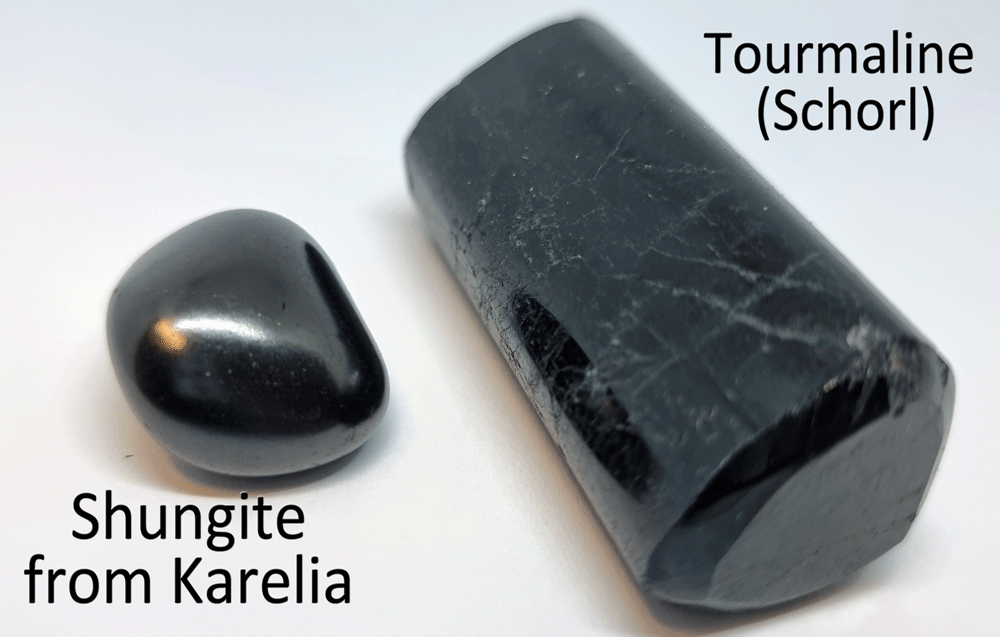
Formation Tourmalines are borosilicate minerals formed through complex magmatic processes. They come in a wide range of colors, including pink and green, and can be both transparent and opaque. Black tourmalines can easily be confused with Shungite.
Physical Characteristics:
Conductivity: Black tourmaline (schörl) does not conduct electricity, unlike Shungite.
Hardness: The hardness of tourmaline is 7 to 7.5, significantly higher than that of Shungite.
Density: With a density of 3.0 to 3.3 g/cm³, tourmaline is heavier than Shungite.
Summary:
Black tourmaline has a needle-like crystal structure, while Shungite is massive and lacks crystalline form. However, when the minerals are processed into beads or other products, they can be easily confused. A simple test helps to differentiate them: try using one of the minerals to operate the smartphone touchscreen instead of your finger. Shungite conducts electricity, causing the screen to respond and be used. Tourmaline, however, shows no such reaction. This test allows a clear distinction.
In addition, tourmaline differs in other properties: it is heavier and harder than Shungite.
6. Hypersthene
Formation Hypersthene is a mineral from the pyroxene group and forms during the crystallization of magnesium-rich, iron-containing igneous rocks. It is typically greenish-gray or deep black and can appear in various forms.
Physical Characteristics:
Conductivity: Hypersthene does not conduct electricity.
Hardness: The hardness is 5 to 6, higher than Shungite.
Density: The density is 3.3 to 3.4 g/cm³, which exceeds that of Shungite.
Summary:
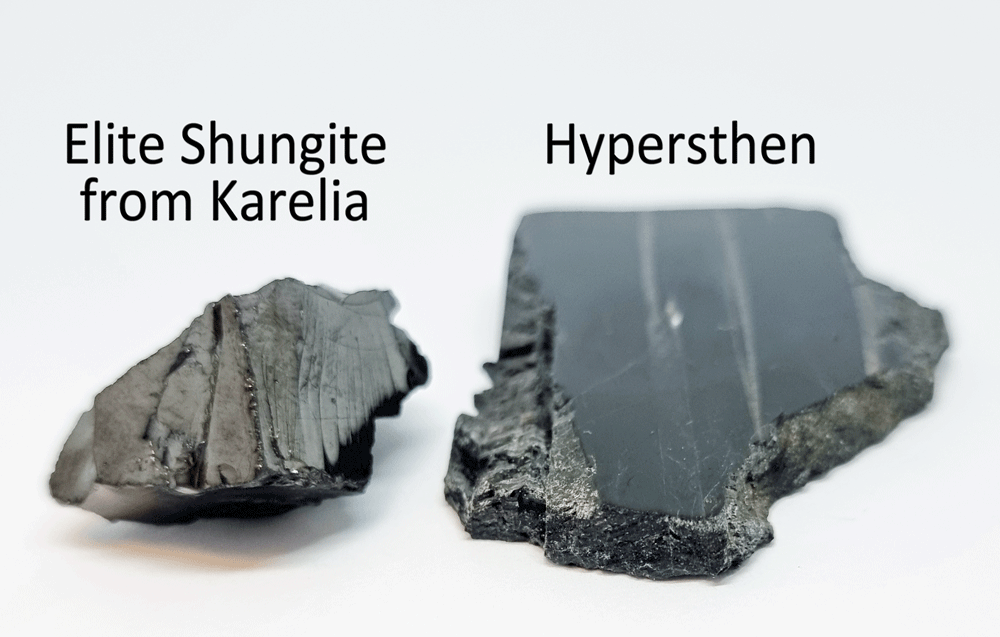
Hypersthene is characterized by its metallic-bronze to greenish-brown shimmer and visible crystal structure. Shungite, on the other hand, is graphite-like, lacking shimmer and crystalline features. However, it can sometimes be confused with Edel-Shungite.
Important:
A test with a smartphone screen does not yield clear results with Hypersthene, as it – like Shungite – triggers a reaction on the screen. This property stems from Hypersthene’s formation in iron-rich igneous rocks. Edel-Shungite, however, is significantly lighter and softer than Hypersthene, making it easier to distinguish the minerals.
Shungite and Edel-Shungite often have optical similarities with other minerals. Unfortunately, fake or colored minerals, as well as plastics, are also circulating, falsely labeled as Shungite. So-called Edel-Shungite stones from Colombia, Spain, or Kazakhstan visually resemble Edel-Shungite from Karelia. However, they differ significantly in composition and have different uses and properties. These minerals have very little in common with authentic Edel-Shungite from Karelia.
If you wish to purchase genuine Shungite or Edel-Shungite, pay close attention to the trustworthiness of the supplier. A reliable vendor can transparently prove the origin of the stones and clearly explain the journey from the mining site to you. Our guide provides additional support to help distinguish real Shungite stones from other minerals.
Here you can watch a video on this topic:
In our range, you will find only authentic Shungite and Edel-Shungite. We source these directly from the deposits in Karelia and guarantee the highest quality for our customers.